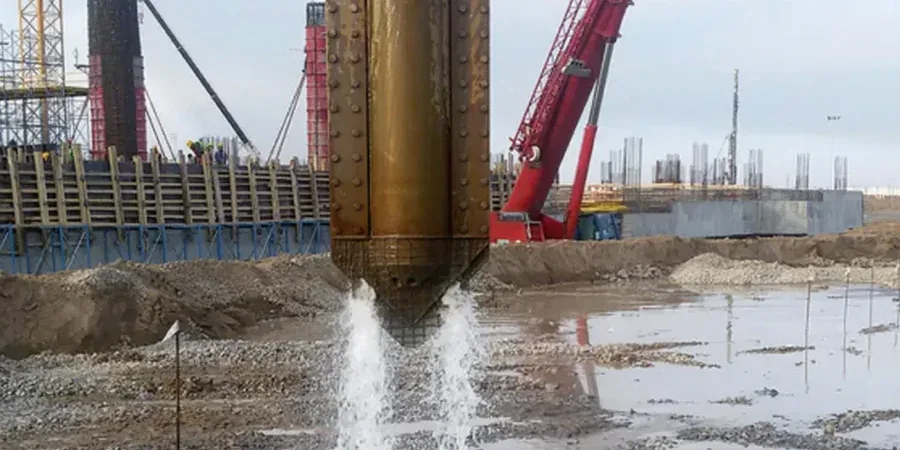
Seattle sits on a complex glacial legacy. The Vashon advance left behind loose sands, silts, and uncontrolled fills across the Duwamish basin and Lake Washington shoreline—materials that densify poorly under simple surcharge. When the Cascadia Subduction Zone or the Seattle Fault triggers ground motion, these deposits can lose shear strength within seconds. Vibrocompaction design in this city has to solve two problems at once: reaching target relative density below the water table and keeping vibration amplitudes within tolerance near buried utilities. The design process integrates CPT testing to map tip resistance before treatment and liquefaction analysis to confirm that post-densification factor of safety exceeds 1.2 under the 2,475-year return period event required by IBC 2021.
Reaching 70 percent relative density below Seattle’s groundwater requires real-time power monitoring, not just a preset grid.
Local ground factors
Assuming a uniform grid spacing without verifying stratigraphy first is the most common mistake on Seattle sites. Glacial advance and retreat left lenses of till, outwash, and lacustrine clay that inter-finger over short distances. A design based solely on pre-construction borings spaced 100 feet apart can miss buried organic silt layers that absorb vibratory energy, leaving untreated pockets that settle differentially after the first wet winter. The correction is a phased approach: run a pilot treatment area with in-situ permeability testing and pre/post CPT pairs, then adjust frequency, spacing, and dwell time before full production. Skipping the pilot phase to save two days of rig time routinely results in re-treatment costs that exceed the pilot budget by a factor of three.
Regulatory framework
IBC 2021 (Seattle amendments) – Chapter 18 soils and foundations, ASCE 7-22 – Minimum design loads, seismic ground motion parameters, ASTM D1586 – Standard penetration test (SPT), ASTM D2487 – Soil classification for engineering purposes, SDCI Director’s Rule 10-2019 – Geotechnical report requirements
FAQ
What does vibrocompaction design cost in Seattle?
Design-only packages for a standard city lot or small commercial site typically range from US$1,440 to US$5,080, depending on the number of treatment zones and required verification borings. Projects requiring a pilot test program or peer review by a third-party geotechnical engineer will be at the upper end of that range.
How deep can vibrocompaction treat Seattle’s glacial soils?
In the loose sands of the Vashon recessional outwash, effective treatment depth reaches 60 to 90 feet with a standard 130 kW vibrator. Where dense Lawton Clay or till is encountered at shallower depths, treatment stops at refusal, which is logged and mapped to confirm the bearing stratum is continuous across the site.
Is vibrocompaction feasible next to existing buildings in Capitol Hill or Ballard?
Feasibility depends on peak particle velocity limits at adjacent foundations. Pre-construction vibration monitoring and a buffer zone of 15 to 25 feet are standard. In tighter conditions, the design may switch to vibro-replacement stone columns, which generate lower radial displacement while still improving liquefaction resistance.
How long does a typical vibrocompaction treatment take in Seattle?
For a 10,000-square-foot site with 8-foot triangular grid spacing, production plus verification testing generally takes five to eight working days. Sites with extensive fill debris or tide-influenced groundwater in the Duwamish corridor may extend the schedule by two to three days to manage water flush and material collapse around the probe.