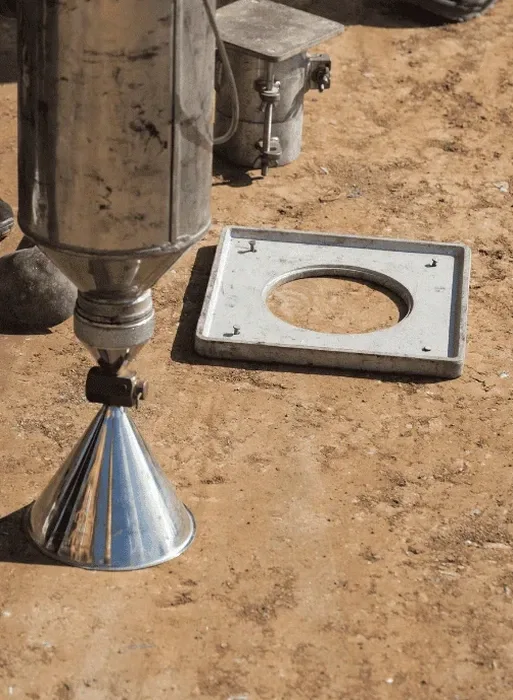
Seattle's regrading legacy, particularly the Denny Regrade that reshaped downtown between 1897 and 1930, left behind a patchwork of engineered fill and glacial drift that still defines construction challenges today. When a contractor places structural fill over Vashon Till or compacted outwash deposits in the Duwamish industrial corridor, verifying achieved density is non-negotiable before footing steel arrives on site. The sand cone test, standardized under ASTM D1556, provides a direct gravimetric measurement of in-place density that no nuclear gauge can match for accuracy in mixed-grain soils with cobble fragments. In a city where the groundwater table often sits within six feet of grade west of I-5, in-situ permeability testing often runs concurrently with density verification to confirm that compacted lifts are not trapping perched water against foundation walls.
The sand cone method remains the referee test for compaction disputes in Seattle because it measures density directly—no calibration curves, no moisture corrections, just a gravimetric volume ratio.
Method and coverage
A recent mixed-use project on Roosevelt Way NE required compaction verification across three distinct soil profiles within a single block: glacially overridden till at the north end, loose urban fill from the 1920s in the center, and thin lacustrine silts overlying the Lawton Clay near the south property line. The sand cone method handled this variability without recalibration delays because the test principle relies on calibrated sand volume displacement rather than backscatter algorithms that struggle with iron-rich till. Crews excavated the test hole through the full lift thickness—typically 8 to 12 inches for DOT-specified structural fill—and funneled Ottawa sand from a pre-weighed apparatus into the cavity. The mass of sand required to fill the hole, subtracted from the initial apparatus weight, gave the excavated volume with repeatability within 0.5 lb/ft³ across five verification points. Critical for Seattle projects subject to the Seattle Building Code Chapter 16 structural design requirements, density results above 95% of modified Proctor (ASTM D1557) were documented on the same shift, keeping the pour schedule intact.
Local ground factors
Seattle's winter saturation cycle presents a compaction verification risk that out-of-state crews frequently underestimate. From November through March, near-continuous light precipitation raises fill moisture content above optimum in exposed excavations across the Central District and Ballard, where the Vashon advance outwash drains moderately well but the overlying fill borrow sources are often borderline silty. Running a sand cone test on material placed at 3 to 5 percent above optimum moisture produces a density reading that appears to pass spec, yet the soil structure contains excess pore pressure that collapses under the first dry-season load cycle, triggering differential settlement at slab-on-grade connections. The IBC Chapter 18 soils investigation requirements for Seattle's Seismic Design Category D structures make compaction documentation a permit-closing deliverable, and density tests performed on rain-soaked lifts without prior moisture conditioning will not survive third-party review. Our field technicians carry portable moisture probes and a propane field oven on every truck to verify moisture-density relationships before cutting the test hole, eliminating the most common source of false-positive compaction results in the Puget Sound basin.
FAQ
What does a sand cone density test cost for a Seattle construction project?
Field density testing with the sand cone method in the Seattle metro area typically ranges from US$90 to US$170 per test point, depending on site access logistics, number of points per mobilization, and whether the project location requires traffic control—common on Seattle Department of Transportation (SDOT) permitted utility work. Projects east of Lake Washington in Bellevue or Redmond often fall at the lower end of the range due to easier staging. The price includes the field technician's time, calibrated sand consumption, and the density calculation report with percent compaction relative to laboratory Proctor values.
How many sand cone tests are required per lift of structural fill?
The Seattle Building Code references IBC Chapter 18, which requires a minimum of one field density test for every 2,500 square feet of each compacted lift, or one test per 150 cubic yards of fill placed, whichever yields more test points. For utility trench backfill under SDOT right-of-way permits, the standard is one test every 150 linear feet per lift, with additional tests at structure crossings. These are minimum frequencies; projects on sensitive sites near steep slopes mapped in the Seattle landslide hazard zone often require tighter spacing specified by the geotechnical engineer of record.
Can the sand cone method be used in gravelly Seattle glacial till?
Yes, with important caveats. The Vashon Till underlying much of Seattle contains subrounded cobbles and boulders that can exceed the 2-inch maximum particle size limit set by ASTM D1556. When a test hole excavation encounters a cobble larger than the allowable size, the technician must abandon that test location, backfill the hole with the excavated material, and move at least one foot laterally to a new point. In till zones with dense cobble concentrations above 30 percent by volume, we recommend supplementing sand cone tests with a nuclear gauge correlation or switching to a large-scale water replacement method per ASTM D5030 to avoid excessive test abandonment rates.