← Home · Slopes & Walls

Retaining Wall Design in Seattle: Geotechnical Data for Lateral Earth Support

Together, we solve the challenges of tomorrow.

LEARN MORE →

Seattle's downtown core rests on regraded glacial till, a legacy of the Denny Regrade that flattened hills into Elliott Bay at the turn of the 20th century. That engineered fill, combined with the city's 47.6° north latitude and steep slope topography, creates demanding conditions for retaining wall design. We see projects from Queen Anne to West Seattle where lateral earth pressures shift dramatically within a single block. Our lab runs direct shear tests per ASTM D3080 and consolidation tests per ASTM D2435 to nail down the effective friction angle and cohesion—numbers that directly feed wall stem and base sizing. Without site-specific parameters, you are guessing on active and passive wedge geometry, and Seattle's saturated winter ground does not forgive guesswork. We also cross-check slope stability when walls exceed 6 feet or sit near a property line with an upslope surcharge.

In Seattle, the difference between a wall that tilts after the first wet season and one that stands for 50 years is usually the quality of the lab data behind the earth pressure coefficients.

Methodology and scope

Moving from the dense glacial overconsolidated soils of Capitol Hill to the loose alluvial deposits along the Duwamish Waterway changes everything in retaining wall design. On the hill, we often see K0 conditions near 1.5, meaning high at-rest pressures that demand stiffer wall sections. Down in the industrial flats, groundwater at 3 feet below grade requires careful drainage design and often a deep excavation support strategy before the permanent wall goes in. We quantify these differences through triaxial CU tests (ASTM D4767) and grain size distribution (ASTM D6913), feeding parameters like effective cohesion c' and drained friction angle φ' into the design. Key characteristics we evaluate:
Retaining Wall Design in Seattle: Geotechnical Data for Lateral Earth Support
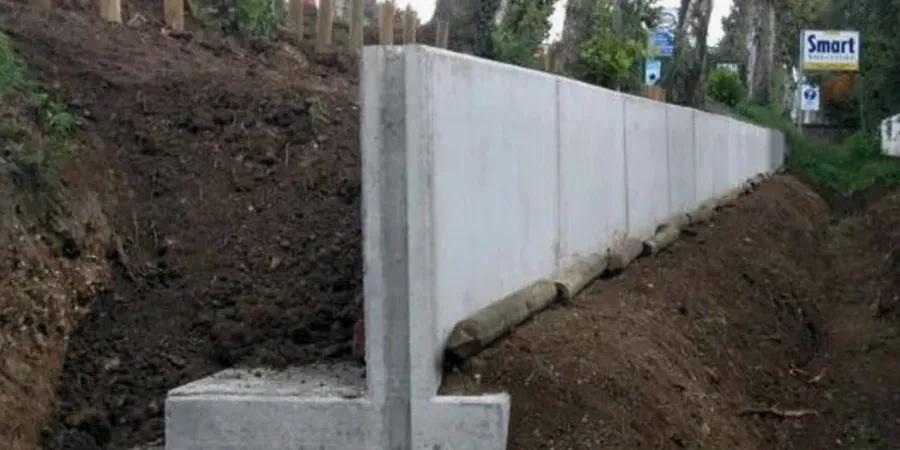
Technical reference image — Seattle

Local ground factors

On a Magnolia bluff project we reviewed, the contractor assumed a clean sand backfill but the lab results showed 18% fines. That changed the drainage behavior completely—the wall design went from free-draining to fully hydrostatic pressure in less than 18 inches of rain, which Seattle delivers reliably between October and March. The most common failure we see is not overturning or sliding in the textbook sense; it is poor compaction behind the heel, leading to settlement that pulls the wall backward and cracks the facing. Another Seattle-specific risk: excavating for a wall toe and encountering a perched water table in the Vashon advance outwash, which can destabilize the cut before the wall is placed. We recommend running in-situ permeability tests at the wall footprint elevation before finalizing the drainage detail.

Need a geotechnical assessment?

Reply within 24h.

Email: contact@geotechnicalengineering.biz

Video resource

Technical data

ParameterTypical value
Internal friction angle (φ')28° – 42° (varies by till density)
Effective cohesion (c')0 – 500 psf (overconsolidated clay)
Active earth pressure coefficient (Ka)0.20 – 0.35 (Coulomb)
At-rest pressure coefficient (K0)0.40 – 0.80 (OC soils)
Allowable bearing capacity2,000 – 8,000 psf (footing width dependent)
Seismic coefficient (kh)0.10 – 0.25 (per ASCE 7-22)
Backfill permeability (k)1×10⁻³ – 1×10⁻⁶ cm/s

Related services

01

Earth Pressure Parameter Package

Direct shear or triaxial CU tests on retained and foundation soils to determine friction angle, cohesion, and unit weight for Coulomb or Rankine analysis.

02

Drainage Material Evaluation

Grain size analysis and permeability testing on proposed backfill to confirm free-draining behavior or design a filtered weep system per FHWA guidelines.

03

Foundation Bearing Verification

Consolidation and strength tests at wall footing elevation to check bearing capacity, settlement, and eccentricity limits under the wall's overturning moment.

Regulatory framework

ASCE 7-22 Minimum Design Loads (Seismic Earth Pressure), IBC 2021 Section 1807 (Retaining Walls), ASTM D4767 Triaxial CU, ASTM D3080 Direct Shear, ASTM D2487 Soil Classification

Frequently asked questions

What ASTM tests do you need for a cantilever retaining wall in Seattle?

At minimum, we run ASTM D2487 for classification, ASTM D3080 direct shear or D4767 triaxial CU for strength parameters (φ' and c'), and ASTM D698 or D1557 for compaction. If the wall is over 12 feet or in a seismic zone, we add cyclic simple shear per ASTM D6528 for liquefaction screening on the foundation soil.

How much does retaining wall design testing cost for a typical Seattle residential project?

For a single-family residential wall under 8 feet, our lab testing package typically ranges from US$900 to US$4,610 depending on the number of shear tests, consolidation tests, and whether we include chemical analysis for sulfate attack on concrete. We provide a fixed-price quote after reviewing the geotechnical scope.

Do you handle Seattle DPD permit submittal requirements for shoring?

Yes. Our lab reports include the soil parameters, classification data, and design recommendations in a format that Seattle DCI reviewers expect. We reference IBC 2021 and ASCE 7-22 throughout, and we sign and seal the geotechnical letter that accompanies the permit drawings.

What is the biggest soil challenge for retaining walls near Puget Sound?

The combination of high groundwater in the winter, loose fill from the Denny Regrade era, and the seismic demand from the Seattle Fault Zone. Walls here need conservative drainage assumptions and seismic earth pressure increments that many standard designs from drier regions miss. Our lab data feeds those site-specific factors into the wall design.
Location and service area

We serve projects in Seattle and surrounding areas.

View larger map