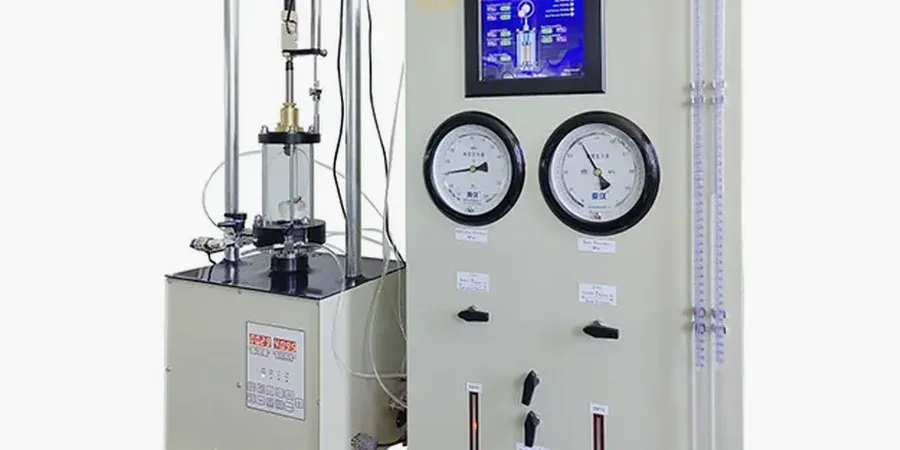
Seattle grew fast after the Denny Regrade leveled hills and dumped them into Elliott Bay, and a lot of that remolded fill is still under downtown blocks today. Up in Capitol Hill, you hit stiff advance glacial till; in Pioneer Square, drillers pull up estuarine muds and loose fill that never saw real compaction. When a structural engineer needs drained and undrained shear strength for a deep excavation or a tower foundation, a generic friction angle from the boring log is not enough. A triaxial test on Shelby tube samples or block specimens gives us the failure envelope the design actually needs: effective cohesion c′, effective friction angle ϕ′, and undrained shear strength Su —all with pore-pressure measurement under controlled drainage. We run these in our Seattle geotechnical lab following ASTM D4767 for consolidated-undrained conditions and ASTM D7181 for consolidated-drained, because the Puget Sound basin demands both. The 2001 Nisqually quake proved that loose alluvium and fill behave very differently under cyclic loading, and triaxial data is what feeds the liquefaction triggering curves in a site-specific response analysis.
A friction angle copied from a textbook table is a liability in Seattle’s glacial and fill sequences — triaxial data replaces guesswork with a measured failure envelope.
Method and coverage
What our lab techs notice running Seattle-area specimens is that the advance outwash from the Vashon glaciation — compact sand and gravel below the till — often gives us peak friction angles above 38° in CD triaxial, but post-peak softening can be abrupt if silt content is higher than expected. In CU tests with pore-pressure measurement, the normally consolidated fill from the Duwamish industrial corridor tends to generate positive excess pore pressure early, which brings down effective stress fast at strains as low as 2%. That is the kind of thing a standard SPT N-value misses entirely, and it is why we often pair triaxial testing with
CPT soundings along the same alignment: CPT gives us a continuous qc and friction sleeve profile, while triaxial puts numbers on the stress-strain behavior at select depths. For projects east of Lake Washington, where glacio-lacustrine clays can be overconsolidated by 150 feet of ice, we run multi-stage CU tests on a single specimen to get a full Mohr-Coulomb envelope without remolding scatter. Specimens are trimmed to 2.8-inch diameter, saturated under backpressure until Skempton’s B exceeds 0.95, and sheared at rates slow enough to let pore pressure equalize — typically 0.01 in/min for low-permeability silts. We report stress-strain curves, p-q diagrams, and interpreted c′ and ϕ′ in a format that slots directly into PLAXIS or FLAC input decks.
Local ground factors
Think about the contrast between Queen Anne Hill and the SoDo waterfront. Queen Anne sits on hard lodgment till with a preconsolidation pressure that can exceed 10 ksf — triaxial CD tests there show a well-defined peak strength and dilative behavior at low confining stress. SoDo, just a mile south across the tide-flat transition, is underlain by young Holocene alluvium and undocumented fill that barely qualifies as engineered backfill. Triaxial CU tests on those soils often produce normalized Su/σ′v ratios below 0.25, and the failure envelope can curve under high confining pressure, which matters a lot for a 30-foot basement excavation. If you skip triaxial and rely on correlations from SPT blow counts alone, you risk underestimating settlement on the stiff side and overestimating bearing capacity on the soft side — both can trigger expensive change orders when excavation shoring starts to move. In Seattle, where groundwater is within 10 feet of grade across much of the basin, effective-stress triaxial parameters are not optional; they are what keeps a retaining wall design from becoming a remediation project.
Regulatory framework
ASTM D4767 – Consolidated-Undrained Triaxial Compression Test on Cohesive Soils, ASTM D7181 – Consolidated-Drained Triaxial Compression Test on Soils, ASTM D2850 – Unconsolidated-Undrained Triaxial Compression Test on Cohesive Soils, ASCE 7 – Minimum Design Loads for Buildings and Other Structures (seismic site class input), IBC – International Building Code (geotechnical investigation requirements, Seattle amendments)
FAQ
What does a triaxial test cost for a Seattle project?
A single CU triaxial with pore-pressure measurement on a 2.8-inch specimen generally runs between US$1,780 and US$2,970, depending on the number of consolidation stages and whether we need to run a multi-stage test to build a full envelope from one tube sample. A typical Seattle deep foundation investigation might include three to six triaxial specimens spread across different strata, so total lab cost depends on how many lithologies you need to characterize.
How do you select between UU, CU, and CD triaxial for Seattle glacial soils?
We match the test type to the drainage condition the soil will expertise in the field. UU (unconsolidated-undrained) is quick and useful for end-of-construction stability in low-permeability clays where pore pressure cannot dissipate. CU (consolidated-undrained) is our default for Seattle silts and clays — you get both undrained strength and effective-stress parameters if we measure pore pressure. CD (consolidated-drained) applies when the loading rate is slow enough that excess pore pressure is negligible, typical for free-draining advance outwash and open-graded gravel interbeds.
What sample quality do you need for a reliable triaxial test?
We need minimally disturbed tube samples — Shelby tubes in fine-grained soils, or pitcher barrel sampling in stiffer glacial till. Sample diameter should be at least 3 inches for a 2.8-inch trimmed specimen, leaving room to pare off remolded edges. Samples should be sealed with wax or MicroShield immediately in the field and shipped upright with vibration isolation. We reject specimens with visible fissures, gravel inclusions larger than one-sixth the diameter, or signs of drying and cracking before trimming.
How do triaxial results feed into Seattle’s seismic site classification?
IBC and ASCE 7 site classification uses shear-wave velocity, SPT N-values, or undrained shear strength in the upper 100 feet. Triaxial CU tests give us Su directly, which we can use to classify soft clay sites (Site Class E) or to justify a higher site class when Su exceeds 1,000 psf. More importantly, the effective-stress parameters from triaxial testing go into nonlinear site-response models that predict how Seattle Basin amplification affects surface spectra — something a simple Vs30-based classification cannot capture.