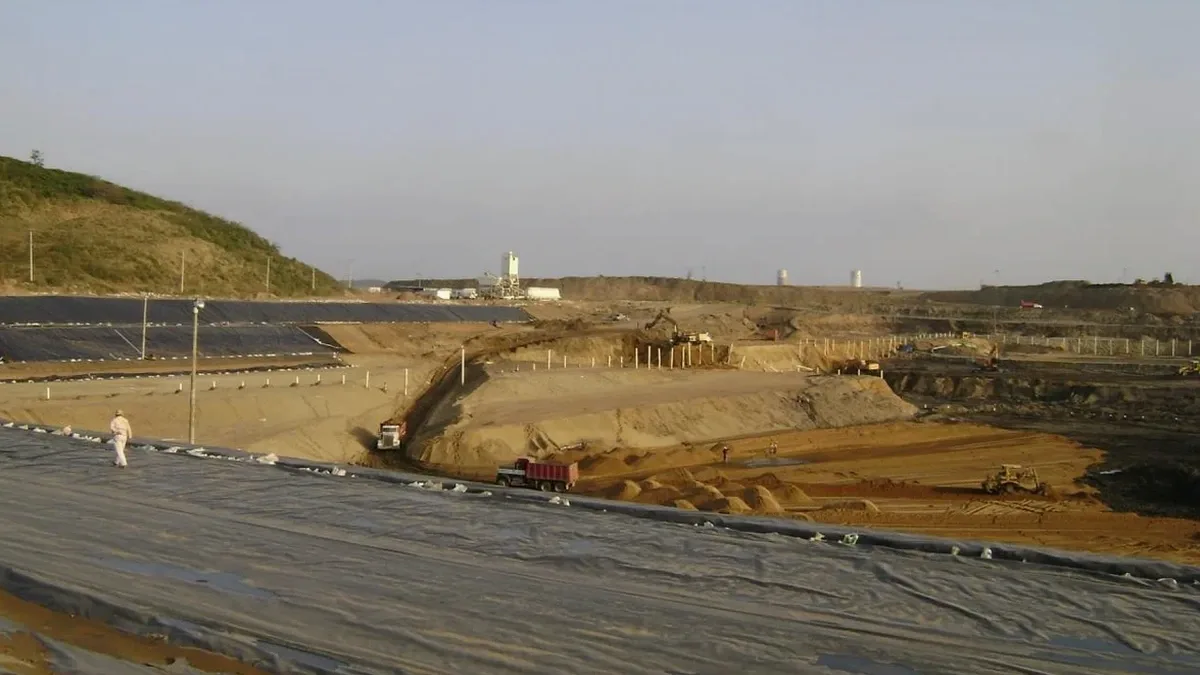
The first thing you see on a deep excavation site in Seattle is the rig positioning the shoring beam—usually a drill or vibratory hammer working against the dense glacial till that underlies much of the city. Getting that beam through the upper fill and into competent bearing is where the design starts. Our lab team focuses on the soil parameters that drive that decision: undrained shear strength from the till, friction angle from the advance outwash, and the groundwater profile that changes with the tide and the season. We run triaxial consolidated-undrained tests on Shelby tube samples pulled from the excavation perimeter, then feed those numbers directly into the finite-element model. For sites near the Duwamish waterway or along the Ship Canal, the interaction between excavation depth and artesian pressure in the lower sand unit becomes the controlling factor. With Seattle’s population now exceeding 755,000 and construction densifying rapidly in South Lake Union and the Denny Triangle, the margin for error on shoring deflection is tighter than ever. We pair lab-derived stiffness parameters with field data from CPT soundings to calibrate the model so the contractor gets a wall section that works without over-excavating.
Seattle’s glacial till provides excellent bearing, but the real challenge lies in managing the fill-till interface and the perched groundwater that collects there.
Method and coverage
A mistake we see too often in Seattle is assuming that the upper fill layer—typically 8 to 15 feet of uncontrolled material from regrades and past construction—behaves like the native Vashon till beneath it. It does not. The fill here can contain everything from sawdust and brick to loose sand lenses that collapse under dewatering, and treating it as a uniform frictional material leads to wall movements that crack adjacent sidewalks and utilities. Our approach separates the fill as a distinct engineering unit. We run
grain-size analyses and Atterberg limits on bulk samples from each stratum, then assign separate Mohr-Coulomb parameters to the fill, the till, and any intervening advance outwash. For excavations deeper than 20 feet, we incorporate the effect of surcharge from adjacent structures using Boussinesq distributions, and we model the staged excavation sequence—not just the final condition. The
retaining-wall design that emerges from this process accounts for the actual stiffness contrast between layers, which in Seattle’s glacial stratigraphy is often the difference between a successful excavation and a costly underpinning.
Local ground factors
Seattle’s urban core sits on a landscape reshaped by the Denny Regrade and decades of waterfront fill placement, which means deep excavations here routinely encounter a chaotic mix of engineered and non-engineered ground. The historical tide flats that once extended into what is now Pioneer Square were filled with sawdust, debris, and hydraulic sluice material—none of it compacted to modern standards. When an excavation cuts into this material, the risk of basal heave or wall kick-out increases sharply, especially if the contractor dewaters without a calibrated groundwater model. We’ve seen cases where a perched water table in the fill, fed by leaking utilities, triggered a blowout at the toe of a shoring wall because the designer assumed a single phreatic surface. Our analysis explicitly maps each water-bearing horizon and runs a seepage analysis to confirm that the passive resistance at the toe is sufficient under both drained and undrained conditions. In Seattle, ignoring the fill’s heterogeneity is not a gamble worth taking.
Regulatory framework
ASCE 7-22 Minimum Design Loads and Associated Criteria for Buildings and Other Structures, IBC 2021 Seattle Amendments (Seattle Building Code Chapter 16), ASTM D1586 Standard Test Method for Standard Penetration Test (SPT) and Split-Barrel Sampling, ASTM D2487 Standard Practice for Classification of Soils for Engineering Purposes (Unified Soil Classification System), FHWA GEC No. 4 Ground Anchors and Anchored Systems, AASHTO LRFD Bridge Design Specifications, 10th Edition
FAQ
What is the typical cost range for a deep excavation geotechnical design in Seattle?
Design fees for a deep excavation in Seattle generally range from US$1,870 for a straightforward single-family basement shoring analysis to US$8,400 for a multi-level commercial excavation with tiebacks, surcharge from adjacent high-rises, and staged construction modeling. The spread depends on excavation depth, proximity to neighboring structures, and the complexity of the groundwater profile.
Which soil unit controls the shoring design in Seattle?
In most Seattle projects, the Vashon glacial till provides excellent passive resistance once the wall penetrates into it. However, the overlying fill and advance outwash often control the upper cantilever portion of the wall and the tieback load distribution. We model each unit separately because treating the fill as till produces unconservative wall sections.
How do you address the seismic component for deep excavation design?
We develop site-specific response spectra per ASCE 7-22 Chapter 19 using the Seattle basin amplification factors. For excavations, the seismic earth pressure increment is added to the static pressure using the Mononobe-Okabe method or through pseudo-static finite element analysis, depending on the consequence class of the structure.
Do you handle the dewatering design as part of the excavation scope?
Yes. Dewatering is integral to deep excavation design in Seattle because the groundwater regime here is complex—perched water in the fill, a phreatic surface in the outwash, and sometimes artesian pressure in the lower sand. We run a seepage analysis, size the well points or deep wells, and check for piping and blowout at the excavation base.