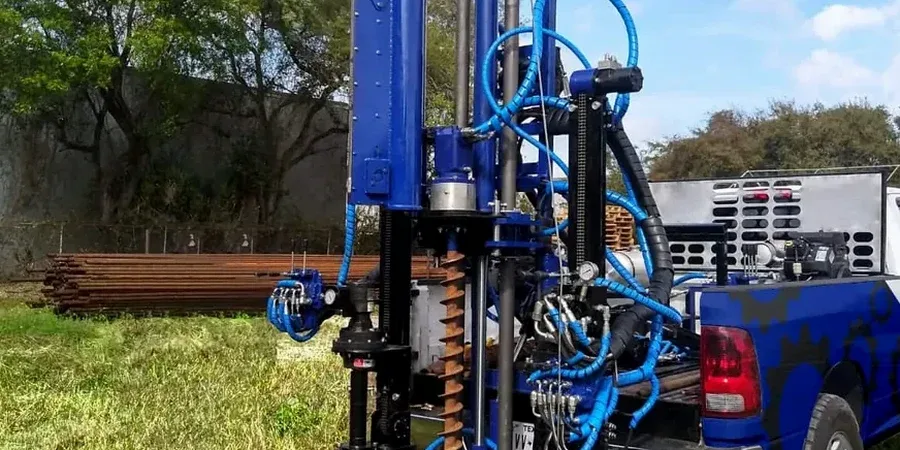
Seattle’s geotechnical profile shifts dramatically within a single city block — dense glacial till overridden by soft alluvium, pockets of saturated sand from Ice Age outwash, and layers of artificial fill from regrading projects a century ago. The Standard Penetration Test remains the most practical way to cut through that uncertainty, delivering N-values at every 2.5 feet that correlate directly with relative density, friction angle, and bearing capacity. Our crews operate in Ballard, Capitol Hill, SODO, and the Duwamish corridor, where the water table often sits less than 10 feet below grade and where the 2001 Nisqually earthquake reminded everyone that loose saturated sand does not forgive assumptions. We record blow counts, sample recovery, and groundwater observations in real time, so the data package that lands on your desk already accounts for Seattle’s winter-saturated conditions and the compaction nuances of Vashon till.
In Seattle’s glacial terrain, three misclassified feet of silt can shift a site class from C to D — SPT data is what prevents that reclassification surprise during plan check.
Local ground factors
We run a CME-75 track-mounted drill rig through the tight alleyways of Pioneer Square and the steep side yards of Queen Anne — the mast folds to clear overhead utilities, and the rubber-track footprint keeps sidewalk pressure below 6 psi so we can work next to century-old unreinforced masonry without triggering settlement. The real risk in Seattle SPT work is not the drilling itself but the misinterpretation of blow counts in gravelly till, where a single cobble can fake refusal at 50 blows and mask a perfectly competent bearing stratum beneath. To catch that, we log the sound of the hammer, the sample recovery, and the torque required to advance the auger — three independent indicators that tell us whether the N-value is real. In the saturated sand lenses that triggered liquefaction in SODO during the 2001 Nisqually quake, we apply overburden correction and energy normalization before the data enters any bearing capacity calculation, because uncorrected N-values in that material can underestimate settlement potential by a factor of two.
FAQ
What does SPT testing typically cost for a Seattle residential project?
For a single-family residential site in Seattle, an SPT boring with 30 to 50 feet of depth and standard logging typically ranges from US$500 to US$850 per boring, depending on access constraints, the need for traffic control in neighborhoods like Wallingford or Fremont, and whether groundwater monitoring is required. Mobilization, soil laboratory testing of SPT samples, and the engineering report are separate line items.
How does the SPT blow count relate to Seattle’s site class determination for seismic design?
Under ASCE 7-22 and the Seattle Building Code, site class is determined by the average SPT N-value (N̄) in the upper 100 feet of the soil column. In Seattle’s glacial terrain, a profile dominated by N-values above 50 blows per foot often corresponds to Site Class C, while softer lacustrine deposits or artificial fill with N-values below 15 can push the classification to Site Class D or E. The N̄ calculation must exclude any refusal intervals and apply proper energy corrections, which is why we document hammer energy ratio on every project.
How long does an SPT investigation take in Seattle, and what affects scheduling?
A single SPT boring to 40 feet in accessible Seattle terrain can be completed in one day, including rig mobilization, drilling, sampling, and backfill. Scheduling is affected by the Seattle DCI permit timeline for right-of-way borings, the seasonal water table — which is highest from December through March and can slow drilling in saturated sands — and the requirement for a utility locate through the Washington 811 system at least two business days before breaking ground.