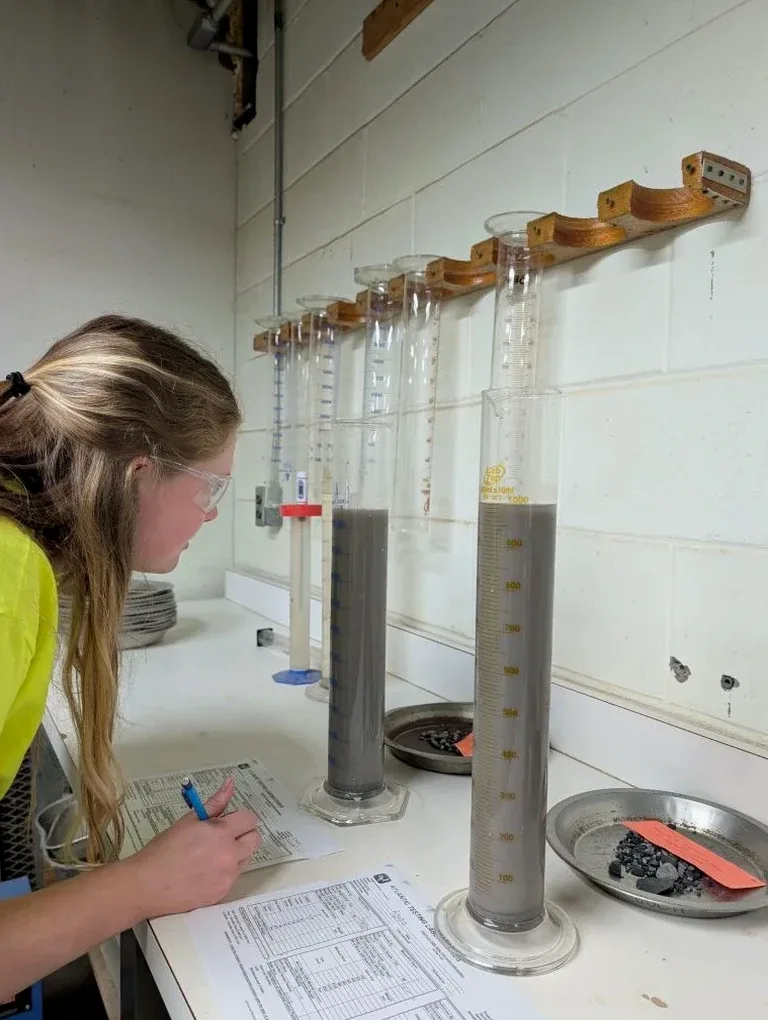
A common mistake we see with Seattle projects is assuming the wet, gray soil on site will behave like the crushed rock used in the contractor's last job in Ellensburg. It won't. Seattle's glacial till and saturated silts lose bearing capacity fast when remolded, and a design based on assumed values—rather than a measured laboratory CBR test—leads to undercutting, over-excavation, or pavement that pumps fines after the first rainy season. With the city receiving 37 inches of rain annually, subgrade moisture is the variable that determines whether your asphalt or concrete section actually survives. We run soaked CBR specimens per ASTM D1883 in our accredited lab so the structural section matches the material you have, not the material you wish you had. When the project is in a former creek drainage or near the Duwamish waterway, we often pair CBR with a grain size analysis to confirm fines content before selecting a stabilization strategy.
Seattle's 37 inches of rain don't ruin pavements—unverified CBR assumptions do. The soaked value is the only one that counts.
Local ground factors
A five-story mixed-use building on Rainier Avenue was designed with a parking slab over what the geotech report described as 'sandy silt.' The structural engineer used a CBR of 10% based on a table in the IBC commentary. After one winter, the slab had settled 1.5 inches at the truck-loading zone. We pulled Shelby tubes from beneath the slab and ran laboratory CBR tests on soaked specimens compacted to the field density measured by nuclear gauge. The actual soaked CBR was 2.8%—the silt had a plasticity index of 12 and the moisture content never dropped below 22% due to capillary rise from the adjacent hillside. The fix required removing the slab, excavating 18 inches, and installing a geogrid-reinforced crushed-rock section keyed to the real subgrade strength. Calibration of the structural section against a measured, soaked laboratory CBR test would have cost less than the demolition, and the city's SDOT pavement restoration requirements are unforgiving once a cut fails inspection.
FAQ
How long does a laboratory CBR test take in Seattle?
The soaked CBR per ASTM D1883 requires a 96-hour (4-day) submersion period after compaction, plus sample preparation and testing time. Our standard turnaround is 5 working days from sample receipt to report. Expedited processing—running multiple molds in parallel—can deliver results in 3 days when the contractor is waiting to finalize the pavement section.
What is the cost of a laboratory CBR test?
A single-point soaked CBR test on one remolded specimen runs US$150. A three-point suite (typically optimum moisture, dry of optimum, and wet of optimum) is US$200. If the sample requires undisturbed tube extrusion or preliminary classification tests, those are quoted separately based on the scope.
Do you need undisturbed or remolded samples for CBR testing?
ASTM D1883 uses remolded specimens compacted in a 6-inch mold, so disturbed bag samples from a test pit or SPT split spoon work well. However, if you need to correlate lab CBR to in-situ density, we also accept undisturbed Shelby tube samples—we trim them into the mold and test without remolding, then compare the result to the field density measured during sampling.
What CBR value does Seattle SDOT require for residential streets?
Seattle's right-of-way improvement manual typically references WSDOT standards, which require a minimum soaked CBR of 5% in the upper 12 inches of subgrade for local access streets. Arterials may require 10% or higher. If the native soil does not meet the threshold, the standard remedy is either undercut and replace with crushed rock or treat the subgrade with lime or cement and retest to confirm the improvement.