← Home · Laboratory

Atterberg Limits Testing for Seattle Clay and Glacial Till

Together, we solve the challenges of tomorrow.

LEARN MORE →

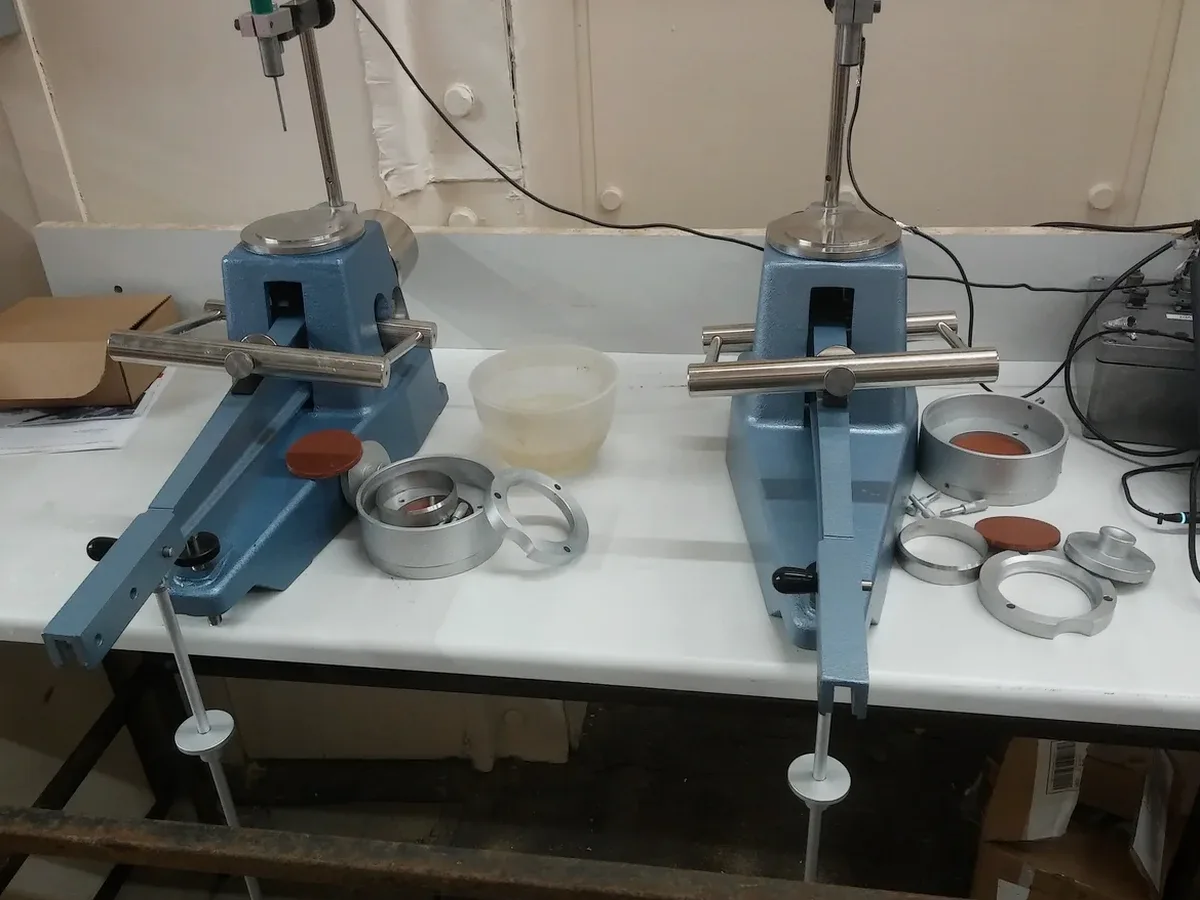
Seattle sits on a complex glacial legacy. The Vashon advance of the Fraser Glaciation left behind thick sequences of overconsolidated till, outwash sands, and the notoriously tricky Lawton Clay. Anyone who has excavated in Queen Anne or along the Lake Washington Ship Canal knows how fast the behavior of these silts and clays can change with just a few percent difference in moisture. The Atterberg limits — liquid limit, plastic limit, and the derived plasticity index — provide the quantitative language to describe that sensitivity. Rather than guessing whether a material will pump, heave, or crack during grading, a grain-size analysis paired with plasticity data lets the engineering team classify the soil within the USCS framework and anticipate its response to seasonal saturation.

In Seattle's glacial soils, the plasticity index is often the single most predictive number for volume change potential.
Methodology and scope

A recent mixed-use project near Northgate ran into trouble when the exposed subgrade, mapped as glacial till, turned out to be lenses of glaciolacustrine silt with high plasticity. The contractor had placed structural fill directly on the interface, and after the first heavy October rain, differential movement appeared at the slab corners. Samples retrieved from the transition zone showed a liquid limit of 48 and a plasticity index of 22 — firmly in the CL-ML range, borderline fat clay behavior. Running Atterberg limits on the re-excavated material confirmed what was needed: a moisture conditioning protocol and a separation geotextile before recompaction. In Seattle's winter construction window, that kind of reactivity is common, and the plasticity index becomes the single most predictive number for volume change potential. When the fines content is high but classification is uncertain, a full triaxial test program on recompacted specimens can verify the shear strength parameters for the engineered fill lift.
Atterberg Limits Testing for Seattle Clay and Glacial Till
Technical reference image — Seattle

Local ground factors

The most frequent mistake we see in Seattle projects is treating all fine-grained glacial soils as low-plasticity silts without verification. A contractor assumes the gray clayey silt at the bottom of a footing excavation is inert, places the rebar, and pours concrete — only to find the soil softens and loses bearing capacity after groundwater rises during the wet season. The difference between an ML silt and a CL fat clay is often invisible to the eye but unmistakable in the Atterberg limits data. A material with a liquid limit above 50 and a plasticity index exceeding 20 will behave very differently under cyclic moisture changes than a lean silt with a PI of 4. Skipping this simple lab test on samples from the bearing stratum can lead to underestimating settlement, overestimating allowable bearing pressure, and ultimately triggering expensive underpinning or slab replacement.

Need a geotechnical assessment?

Reply within 24h.

Email: contact@geotechnicalengineering.biz

Technical data

ParameterTypical value
Test StandardASTM D4318
Liquid Limit (LL)Determined by Casagrande cup or fall cone method
Plastic Limit (PL)Thread rolling method at 3.2 mm diameter
Plasticity Index (PI)Calculated as LL - PL
Soil ClassificationUSCS per ASTM D2487
Sample PreparationWet or dry preparation, sieved through No. 40
ReportingLL, PL, PI, liquidity index, USCS symbol

Related services

01

Plasticity Index Determination

Full liquid limit and plastic limit testing on fine-grained soils to calculate the plasticity index and assign the correct USCS group symbol per ASTM D2487.

02

Moisture Sensitivity Screening

Multi-point Atterberg limits on soil profiles to map the variation of plasticity with depth, critical for cut-and-fill projects in Seattle's variable glacial stratigraphy.

Regulatory framework

ASTM D4318 — Standard Test Methods for Liquid Limit, Plastic Limit, and Plasticity Index of Soils, ASTM D2487 — Standard Practice for Classification of Soils for Engineering Purposes (Unified Soil Classification System), IBC 2021 Section 1803 — Geotechnical Investigations

Frequently asked questions

How much does Atterberg limits testing cost per sample?

Standard liquid limit and plastic limit testing generally ranges from US$60 to US$110 per sample, depending on whether the material requires extended preparation or if a full suite of classification tests is bundled.

How long does it take to get results from an Atterberg limits test?

For routine construction-phase testing, we can often return results within 24 to 48 hours after the sample is received. Samples that require air-drying or have high organic content may need an extra day of preparation.

Why does the plasticity index matter for my Seattle foundation?

The plasticity index directly correlates with a soil's ability to shrink and swell with moisture changes. In Seattle's seasonal climate, a soil with a PI above 15 can undergo significant volume change, which translates into slab movement, cracking, and loss of bearing capacity if not properly mitigated.

Location and service area

We serve projects in Seattle and surrounding areas.

View larger map