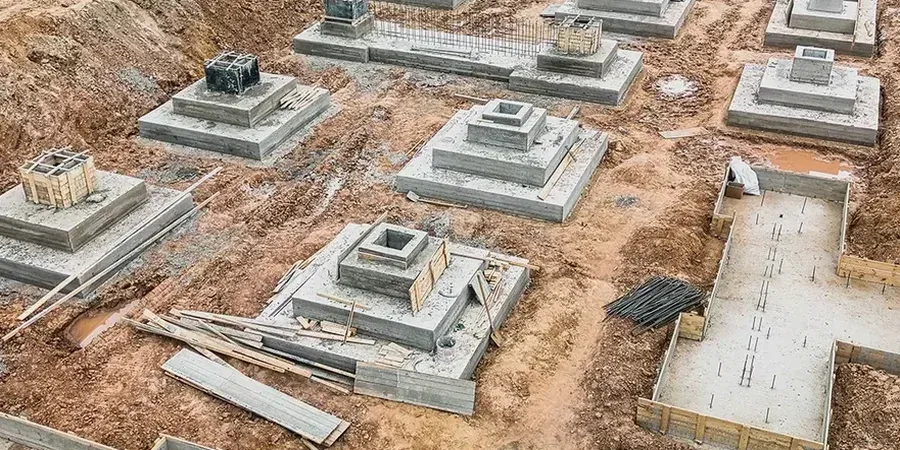
Anyone who has excavated in Seattle's urban core knows the drill—glacial till can appear at 15 feet on one block and vanish into a 60-foot basin of loose fill on the next. Designing pile foundations here is less about applying a generic formula and more about interpreting a subsurface puzzle shaped by the Vashon glaciation and the Seattle Fault Zone. The team integrates CPT test data and laboratory index testing to map these transitions, because a pile tip bearing in overconsolidated till behaves fundamentally differently than one socketed into the deep lacustrine deposits found beneath Pioneer Square. Getting the geotechnical model right before steel goes into the ground is what separates a foundation that settles predictably from one that becomes a costly post-construction surprise.
Seattle's glacial stratigraphy means two piles 100 feet apart can behave like they are on different continents—knowing which till layer you are in is everything.
Local ground factors
Comparing a site in the Interbay area with one in the Madison Valley illustrates how Seattle's glacial history creates starkly different pile design risks. Interbay sits on a deep trough of compressible fill and marine deposits where piles must penetrate up to 100 feet to find competent bearing, and downdrag loads from consolidating fill can consume a significant portion of the pile's structural capacity. Madison Valley, by contrast, often has dense glacial till at relatively shallow depth, but the steep slope instability and potential for lateral spreading along the hillside introduce bending demands that govern pile section selection. The common thread is that neither site forgives a standardized design approach. The IBC requires site-specific geotechnical investigation for deep foundations, and the City of Seattle's DPD review process demands that the pile design explicitly address the Seattle Fault scenario. Our approach documents every design assumption against the field data so that the structural engineer receives a foundation recommendation package that satisfies both the code letter and the subsurface reality.
Regulatory framework
IBC 2021 (Seattle Building Code) – Chapter 18: Soils and Foundations, ASCE 7-22 – Minimum Design Loads and Associated Criteria for Buildings and Other Structures, ASTM D1586 – Standard Test Method for Standard Penetration Test (SPT) and Split-Barrel Sampling of Soils, ASTM D2487 – Standard Practice for Classification of Soils for Engineering Purposes (Unified Soil Classification System), AASHTO LRFD Bridge Design Specifications – Section 10: Foundations, City of Seattle Director's Rule 7-2015 / Environmentally Critical Areas (ECA) requirements
FAQ
What is the typical cost range for a pile foundation design package for a Seattle commercial building?
For a mid-rise commercial structure in Seattle, the geotechnical investigation and pile foundation design package typically ranges from US$1,640 to US$7,050, depending on the number of borings, depth of exploration, and complexity of the seismic analysis required. Projects in liquefaction-prone zones or with deep soft soils near the Duwamish will trend toward the upper end of that range due to the additional testing and modeling involved.
How does the Seattle Fault affect pile foundation design compared to a standard seismic zone?
The Seattle Fault is a crustal fault capable of producing a magnitude 7+ event directly beneath the city, which generates both strong shaking and potential surface rupture. Unlike a subduction zone earthquake, the high-frequency motion from a crustal event puts more demand on pile head connections and can induce liquefaction in the loose granular soils common in the basin. Our design explicitly includes the Seattle Fault scenario per ASCE 7-22 and evaluates kinematic pile-soil interaction to prevent brittle failure modes.
Do you design both driven piles and drilled shafts for Seattle conditions?
Yes, we carry out design parameters for driven H-piles, pipe piles, micropiles, and drilled shafts. The choice depends on access constraints, noise/vibration restrictions common in dense Seattle neighborhoods, and the depth to competent bearing. For instance, a tight urban infill site on Capitol Hill with limited headroom might favor micropiles, while a waterfront redevelopment with deep soft soils could require driven pipe piles to reach the advance outwash.
What level of geotechnical investigation is required before you can provide a pile design?
We need at least one deep boring or CPT sounding that extends below the anticipated pile tip elevation by a minimum of 10 feet, or into competent bedrock. For sites with variable stratigraphy, the IBC requires multiple exploration points. We also need laboratory classification and strength testing on the bearing stratum. The investigation must be sufficient to assign a Site Class and to evaluate liquefaction potential, which in Seattle often means going 80 to 100 feet deep in the basin fill.