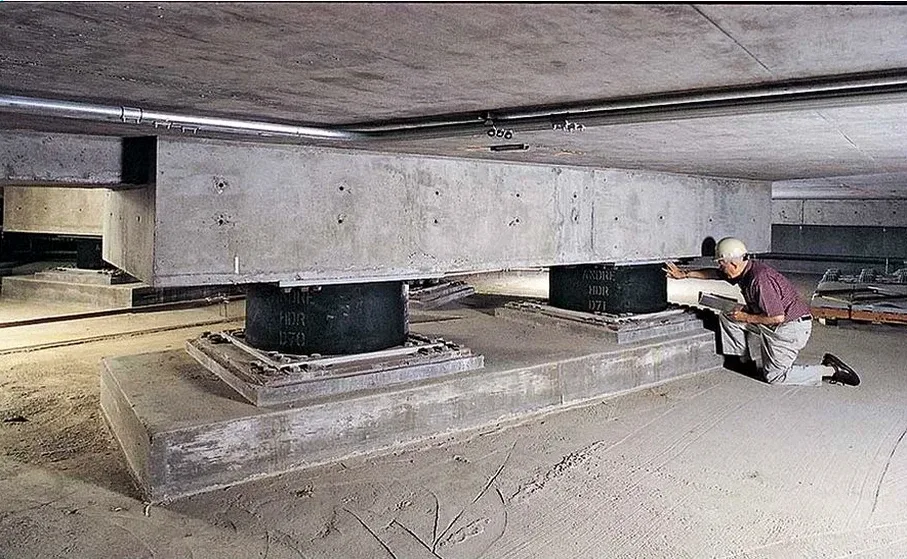
We still see design teams in Seattle specifying fixed-base assumptions for structures sitting on liquefiable fill near the Duwamish. That decision gets expensive fast. The 2001 Nisqually earthquake was a 6.8 moment magnitude event centered 35 miles away, and it still cracked unreinforced masonry from Pioneer Square to Capitol Hill. Base isolation seismic design breaks the load path between ground motion and the superstructure. Energy dissipates at the isolation plane instead of tearing through shear walls and moment frames. For a city built on glacial till, soft alluvium, and reclaimed tide flats, the performance gap between fixed-base and isolated response becomes obvious once you look at spectral acceleration curves. We pair isolation system selection with a site-specific liquefaction analysis to confirm that the isolation plane sits on competent bearing strata, not on soil that will lose stiffness during shaking.
Seattle sits on the Seattle Fault and the Cascadia Subduction Zone. One is shallow and fast. The other is deep and long-period. Base isolation handles both.
Local ground factors
Seattle has a population of 755,000 and a building stock that mixes century-old unreinforced masonry with modern high-rises on the same block. The Seattle Fault runs directly beneath downtown and has produced a magnitude 7-plus event roughly every 750 years. The last one was about 1,100 years ago. A shallow crustal rupture under SoDo or the International District would generate vertical accelerations that fixed-base structures are not detailed to absorb. Base isolation seismic design decouples the building from that vertical component to a significant degree. Without it, post-earthquake functionality is a gamble. ASCE 7-22 risk-targeted maximum considered earthquake maps place most of King County in high-seismic design categories. Owners who delay the isolation decision until schematic design pay for it in structural rework, longer permitting review, and higher contractor contingencies.
FAQ
What does base isolation design cost for a typical Seattle mid-rise project?
Engineering fees for a complete isolation design package on a mid-rise building in Seattle typically range from US$3,700 to US$9,010 depending on the number of isolators, complexity of the superstructure, and whether peer review is bundled. The isolator hardware itself is a separate procurement cost paid directly to the manufacturer.
Does Seattle's building code mandate base isolation for any occupancy type?
The Seattle Building Code adopts IBC 2021 with local amendments. Base isolation is not mandated universally, but it becomes the preferred path for Risk Category IV structures (hospitals, fire stations, emergency operations centers) when the design team wants to demonstrate immediate occupancy performance. The code provides a clear compliance path under ASCE 7-22 Chapter 17 that many reviewers now expect for essential facilities on soft soil sites.
How do you handle the moat detail when the building is on a zero-lot-line site?
Seattle has dense urban sites where the building footprint nearly touches the property line. We design internal seismic gaps within the building footprint, often by cantilevering the superstructure over the isolation plane and placing the moat under an architectural reveal. Utility crossings use flexible couplings rated for the full design displacement. The structural solution is straightforward; the coordination with architecture and waterproofing is where most of the detailing effort goes.
Can base isolation be added to an existing building without demolishing it?
Yes. The building is temporarily supported on jacking columns while the existing columns are cut at a single horizontal plane. New isolators are inserted, load is transferred, and the temporary supports are removed. We have done this on occupied buildings in Seattle by phasing the work in quadrants. It requires careful construction sequencing and continuous monitoring, but it is proven technology.
What ground motion records do you use for Seattle analysis?
We select and scale ground motion suites consistent with the ASCE 7-22 site-specific hazard. Because Seattle sits in a deep sedimentary basin, we include records that capture basin amplification effects. The 2001 Nisqually record from the Seattle accelerograph network is one of several seed motions we use to capture the crustal and subduction characteristics that define the local seismic environment.